

Key Takeaways
- Some diesel warning lights allow limited driving, while others mean the truck should be parked immediately.
- Power loss, overheating, smoke, fluid leaks, and severe mechanical noise require prompt action.
- DPF and DEF warnings can involve more than a low fluid level or a routine regeneration.
- Fault codes are useful starting points, but testing is needed to confirm the root cause.
- Service records and regular inspections reduce surprise downtime and repeat repairs.
A diesel truck can keep running even when an important system is starting to fail. That is why a warning light, a change in performance, or an unusual sound should never be dismissed as “just a diesel thing.” Early attention can prevent a minor sensor, fuel, cooling, or emissions issue from becoming a costly breakdown. For drivers dealing with persistent warning messages, power loss, or Cummins-specific concerns, professional Cummins repair Denver services can help identify the actual cause before unnecessary parts are replaced.
The right response depends on the warning and the symptoms around it. A routine maintenance reminder is not the same as low oil pressure, overheating, a flashing light, or a warning message about an impending power reduction. Learning to recognize the difference helps protect the truck, the driver, and the workday.
Why Diesel Truck Warnings Deserve Quick Attention
Modern diesel engines use several connected systems to manage fuel delivery, turbocharger boost, cooling, exhaust treatment, and emissions controls. A truck may still start and drive while one of those systems is operating outside its normal range. Continued driving can turn a small exhaust-temperature sensor issue into a plugged filter, a minor coolant leak into an overheating event, or contaminated fuel into widespread injection-system damage.
For work trucks and fleet vehicles, the cost is not limited to the repair invoice. Missed appointments, delayed loads, towing costs, and lost labor time can quickly turn a preventable problem into a more expensive one. Treat dashboard messages as useful early warnings, not inconveniences to clear and forget.
The First Signs That a Diesel Truck Needs Service
Warning lights are only one part of the picture. Schedule diagnostics promptly if the truck develops any of these symptoms:
- Reduced acceleration, sluggish response, or an unexpected power limit.
- Hard starting, long cranking, rough idle, surging, or stalling.
- More frequent regeneration cycles or new emissions-system messages.
- Higher fuel consumption without a meaningful change in load, route, or driving conditions.
- Black, white, or blue exhaust smoke.
- Oil, coolant, fuel, or DEF leaks.
- Tapping, knocking, grinding, whining, or hissing noises.
- Engine temperature rising beyond its usual range, especially while towing or climbing.
When a Dashboard Light Means “Drive Carefully”
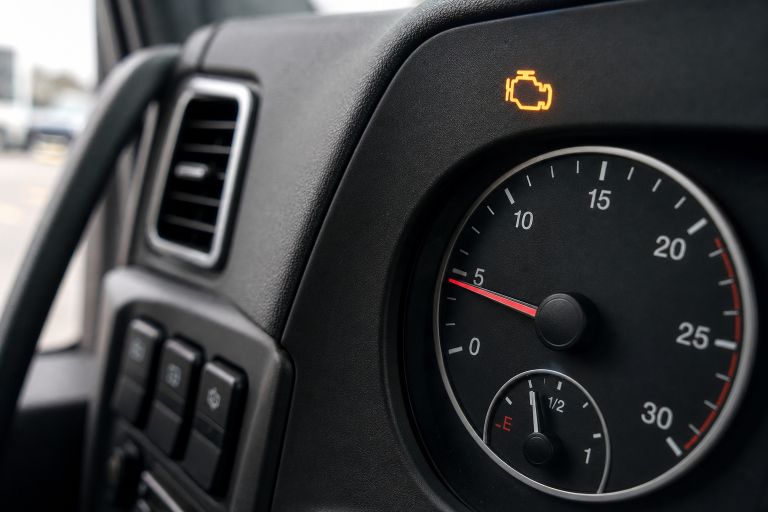
Not every warning requires an immediate tow. A steady check-engine light with normal performance, a routine service reminder, or a regeneration message that matches the owner’s manual may allow limited operation. A low-fluid-level alert may also allow a short trip to obtain the correct fluid, provided there is no leak, overheating, or drivability issue.
What to Do Before Continuing
- Reduce heavy towing, hard acceleration, and unnecessary idling.
- Read the exact dashboard message and consult the owner’s manual.
- Write down when the warning appeared, outside temperature, load, and driving conditions.
- Arrange diagnostic testing as soon as practical, even if the light later disappears.
When the Truck Should Be Parked
Stop in a safe location and arrange assistance when a warning is paired with a serious symptom. Continuing to drive can cause engine damage, create a fire risk, or leave the truck stranded in an unsafe place.
- Low oil-pressure warnings, severe overheating, steam, or a strong coolant odor.
- Flashing warning lights or messages indicating immediate derate, speed restriction, or shutdown.
- Heavy smoke, strong fuel odors, or exhaust fumes entering the cab.
- Sudden loss of braking, steering, throttle control, or major engine power.
- Deep knocking, grinding, loud turbocharger noise, or rapid fluid loss.
What DPF and Regeneration Messages Mean
The diesel particulate filter, commonly called the DPF, captures soot from the exhaust. During regeneration, the exhaust system raises the temperature to burn off accumulated soot. Short trips, long idle periods, stop-and-go use, and light-load driving can make it harder for a truck to complete that process.
A normal regeneration can often occur while driving, but the owner’s manual should always guide the driver. A failed regeneration or a returning DPF light may indicate excess ash buildup, a pressure or temperature sensor issue, an exhaust leak, or an engine fault producing too much soot. This aftertreatment maintenance overview explains why regeneration removes soot but does not eliminate the ash that eventually requires professional filter cleaning or replacement.
DEF and Emissions-System Warnings in 2026
Diesel exhaust fluid warnings do not always mean the tank needs to be filled. Low fluid, poor-quality DEF, contamination, crystallized deposits, damaged wiring, heater failures, pump issues, and inaccurate sensors can all trigger alerts. Never add water, fuel, additives, or unknown fluids to a DEF tank.
Basic checks include confirming the DEF level, using fluid that meets the vehicle manufacturer’s specification, and looking for crystallized residue around the filler neck or nearby lines. If the warning remains after correcting a verified low level, testing is needed. The EPA’s DEF-system update provides additional background on the operational concerns associated with DEF-related faults and power reductions.
Fuel, Cooling, and Turbocharger Clues
Fuel-delivery problems may cause extended cranking, rough idle, surging, weak pulling power, metallic noise near the high-pressure fuel system, or sudden changes in fuel economy. Water or debris in a fuel filter deserves immediate attention because contamination can spread through pumps, rails, injectors, and lines.
Cooling-system faults may show up as coolant loss, temperature swings during hill climbs, wet hoses, white exhaust vapor, or a heater that blows cool air while the engine runs hot. Turbocharger symptoms can include a new high-pitched whine, a hissing sound under acceleration, a slow boost response, smoke, or oil where it was not previously present. These symptoms overlap, so a boost leak, injector issue, intercooler fault, or exhaust restriction should not automatically be blamed on the turbo.
A Simple Response Plan for Drivers
- Stay safe. Move out of traffic if power drops, temperature rises, or a serious mechanical symptom appears.
- Record the message. Take a photo of the dashboard and note the conditions when it occurred.
- Check the basics. When safe, inspect fluid levels, visible leaks, loose connections, tires, belts, and hoses.
- Avoid guessing. Do not repeatedly clear codes or replace expensive components based only on symptoms.
- Share the history. Tell the technician about recent fuel purchases, towing, weather, prior repairs, and recurring alerts.
How Diagnostics and Maintenance Prevent Bigger Repairs
A fault code identifies where the truck detected an abnormal condition, not always the failed part. A sensor code may be caused by wiring or contamination. A low-boost code may indicate a hose leak, actuator issue, intake restriction, or turbocharger issue. A DPF code may stem from temperature sensors, exhaust pressure, fuel delivery, or an incomplete regeneration.
Ask whether the diagnostic process includes a visual inspection, live scan-tool data, electrical checks, pressure testing, and a post-repair road test when appropriate. Then protect the repair with regular oil and filter changes, correct fluids, scheduled fuel filter replacement, reduced idling, clean cooling stack airflow, and inspections of hoses, wiring, and connectors.
Conclusion
Diesel truck warning lights are easier to manage when drivers consider the full picture: the dashboard message, performance change, sounds, smoke, temperatures, and fluid condition. Fast action does not always mean a major repair. Often, it means finding a manageable issue before it affects the engine, fuel system, turbocharger, cooling system, or aftertreatment equipment. Accurate testing and consistent maintenance remain the most practical ways to keep a diesel truck reliable in 2026.