Intel stock fell about 29% on Oct. 30, 2026 after a weak holiday-quarter forecast tied to an AI-driven memory shortage and an Israel factory shutdown. Here’s what happened and what it means for laptop and PC prices.





November 20, 2026


 Kara
Intel stock fell about 29% on Friday, Oct. 30, 2026, its worst day in decades, after the chipmaker warned that holiday-quarter sales will come in well below what Wall Street expected. The short version: Intel’s third quarter was actually good, but its forecast was not. A shrinking PC market, squeezed by an AI-driven memory chip shortage, plus a deadly accident that shut down one of its factories in Israel, pushed Intel’s outlook more than $1 billion under estimates. Here’s what happened, why it matters beyond the stock market, and what it could mean if you’re planning to buy a laptop or desktop soon.
This article explains the news. It is not investment advice.
Intel reported third-quarter results after the market closed on Thursday, Oct. 29. Shares dropped more than 20% in after-hours trading, and the slide deepened on Friday. CNBC reported the 29% drop was Intel’s worst day since the 1970s, while Reuters said the stock was on course for its biggest one-day decline ever, wiping out more than $146 billion in market value.
The fall stung because Intel had been one of 2026’s big comeback stories. Before the report, the stock was up about 150% for the year, helped by strong demand for the server processors that run AI agents and chatbots.
According to CNBC’s earnings breakdown, using analyst estimates from LSEG:
For the current quarter, Intel guided to revenue of $15 billion to $16 billion and adjusted earnings of 25 cents per share. Analysts had expected about $17.1 billion in revenue and 43 cents per share. Reuters also reported that Intel does not expect positive cash flow this year, which added to the worry.
“We see the PC slowdown continuing at least through the first half of next year,” Intel CFO David Zinsner said in the company’s release, as quoted by CNBC. The same hardware crunch is showing up in retail, too: read why Amazon is canceling GPU orders and closing accounts.
Three things came together at once.
On the earnings call, Intel said it now expects total PC unit sales across the industry to fall about 12% in 2026, with the second half of the year down more than 20%. For 2027, it’s planning for roughly another 10% decline. Management said it does not expect a sustained recovery “until memory availability improves and pricing begins to normalize.”
The root cause is memory. Chipmakers have shifted production toward the high-bandwidth memory used in AI servers, which has made ordinary DRAM and storage chips scarce and expensive. That pushes up the cost of building every laptop and desktop, so fewer people buy them. As Reuters put it, the AI buildout is causing “far-reaching strains” across companies that depend on consumer devices, from Dell to Sony to Samsung.
Earlier in October, an explosion at an Intel factory in Israel killed two workers and seriously injured a third. CEO Lip-Bu Tan called it an “unfortunate and tragic accident” that caused an extended shutdown affecting 10-nanometer chips. Intel estimates the incident will cost about $600 million in lost revenue over two quarters, including roughly $300 million in the current quarter.
Not everyone thinks it’s just bad luck. Seaport Research Partners analyst Jay Goldberg told Reuters: “Intel is producing too many chips for consumer PCs in the worst PC market in 15 years, while it is not making enough chips for AI servers in the biggest growth cycle ever for semis. Bad planning is the cause.” D.A. Davidson also downgraded the stock to neutral in a note titled “Not fixed yet.”
Intel’s warning spread across the tech sector on Friday. Reuters reported that AMD, Arm, Qualcomm, Nvidia, Broadcom and Micron fell between 4% and 12%, and server makers Dell, Hewlett Packard Enterprise and Super Micro Computer dropped between 6% and 11%. Overseas, ASML and Samsung Electronics also slid.
Two big shareholders took notable paper losses. The U.S. government, which took a 10% stake in Intel in August 2025, saw the value of its holding drop by about $12 billion, and Nvidia’s stake lost about $6 billion in value, according to CNBC.
The selloff also landed in an already nervous week for Big Tech. Forbes noted Amazon reported $77.3 billion in capital spending for the third quarter, and Alphabet lost nearly $500 billion in value the day after its own earnings, as investors questioned how much the AI race is costing. If you’ve been following the market this month, our explainer on the Oct. 28 Fed meeting and our look at the Anthropic IPO cover the other big stories moving tech stocks.
For most people, the more useful takeaway isn’t Intel’s share price. It’s what Intel just confirmed about computer prices: the memory shortage is real, and the company doesn’t expect it to ease in 2027.
Earlier this year, research firm TrendForce estimated that rising memory and processor costs could push the price of a mainstream $900 laptop up by nearly 40% if brands keep their usual margins. TrendForce also reported that Intel had raised prices on some entry-level and older laptop processors by more than 15%. HP told investors in February that memory and storage would make up about 35% of its PC production costs this year, up from roughly 15% to 18% in late 2025, according to Channel Dive.
Nobody can promise where prices go next, but a few practical points follow from what these companies are saying:
Intel is betting on two things. First, demand for its server processors remains strong: data center and AI revenue grew 78% last quarter, and the company says it is investing to increase supply. Second, it’s pinning its PC hopes on Nova Lake, its next family of PC chips coming in 2027, which Zinsner called “the best set of products we’ve had in a very long time” on the call. The company also still has a large cash cushion, with about $54 billion in cash and short-term investments at the end of the quarter, according to its earnings call.
The open questions are how long the memory shortage lasts, how quickly the Israel factory returns to full output, and whether Intel can shift more of its manufacturing toward AI chips.
Intel forecast fourth-quarter revenue of $15 billion to $16 billion, well below the roughly $17.1 billion analysts expected, citing a weak PC market caused by expensive memory chips and a factory shutdown in Israel. The stock fell about 29% on Oct. 30, 2026.
No. Third-quarter revenue rose 21% to $16.51 billion and adjusted earnings of 52 cents per share beat estimates. The sell-off was about the outlook, not the quarter that just ended.
Industry forecasts point that way. Intel says memory costs will keep weighing on the PC market into 2027, and TrendForce has estimated a mainstream $900 laptop could cost nearly 40% more if memory and processor costs both rise and brands keep their margins.
An explosion earlier in October killed two workers and seriously injured a third, leading to an extended shutdown of 10-nanometer chip production. Intel expects about $600 million in lost revenue over two quarters.
Yes. The government took a 10% stake in August 2025, making it Intel’s largest shareholder, according to Reuters. Friday’s drop cut the value of that stake by about $12 billion.
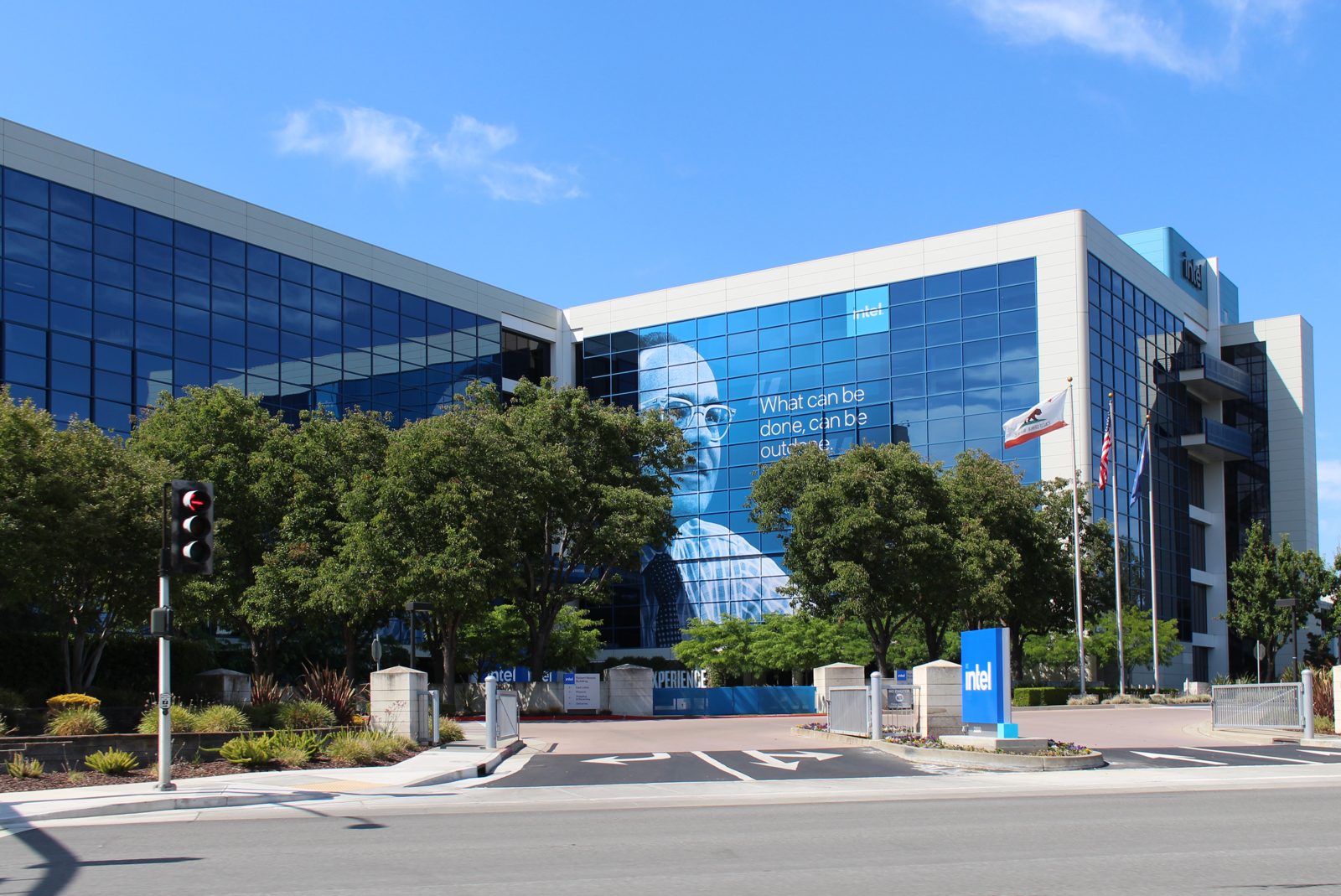
Featured image: Intel headquarters in Santa Clara, California, by Coolcaesar, via Wikimedia Commons, licensed CC BY-SA 4.0.